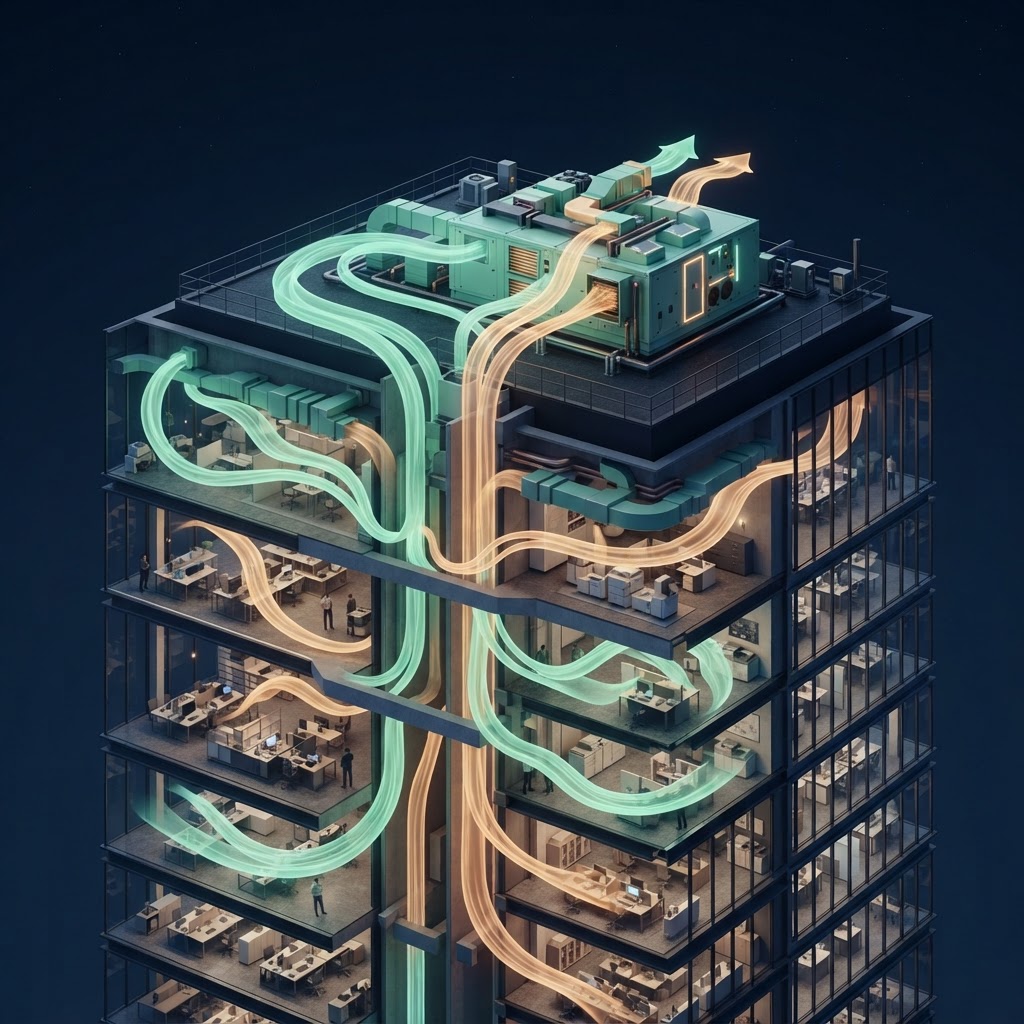
Brown discount → green premium · evidence, not estimates
Escape the brown discount → Release the green premium
Asset owners are losing value to the brown discount — lower rents, higher vacancy, softer yields and costlier debt. Intelli-BuildAI measures the gap, engineers, costs and funds the measures that close it, and evidences the green premium to valuers and lenders — across ten modules from EUI intake to financial reporting, on one auditable asset record.
Up to 73%energy & emissions savings potential — the performance behind the green premium
The value gap
Every building now sits on one side of the line
Occupiers, investors and lenders price energy and carbon performance into rent, vacancy, yield and the cost of debt. Inefficient, poorly evidenced assets carry a brown discount; high-performing, evidenced assets command a green premium. The difference between the two is value an owner either releases — or quietly loses at every letting, valuation and refinance.
Brown discount — value lost
Lower achievable rents and longer void periods
Higher vacancy as occupiers move to efficient, certified space
Yield expansion and lower capital values at valuation
Stranding risk as carbon intensity crosses the decarbonisation pathway
Minimum-standard restrictions on letting, sale and refinancing
Higher cost of debt, tighter covenants and a narrower buyer pool
Green premium — value released
Rental premium for efficient, certified space
Lower vacancy and stronger tenant retention
Yield compression and higher capital values
Lower operating cost lifting net operating income
Access to green loans and sustainability-linked finance
A future-proofed, liquid asset with a defensible exit
01 · MeasureA reproducible baseline, benchmark and stranding year — the brown-discount exposure, quantified.
02 · OptimiseEngineer, cost and fund the measures that close the gap, with up to 73% energy & emissions savings potential.
03 · ValuePrice the green premium from dated, sourced market data for the asset's own city and sector — rent, vacancy and yield.
04 · ProveCarry the evidence to valuers, lenders and buyers from one auditable record — so the premium is paid, not argued.
Premium and discount ranges vary by city, sector and asset; the platform draws them from its validated market register, each range dated and sourced. Results are project-dependent and subject to building type, system design, operating conditions and implementation.
Ten modules that release the value
Module 01 — Module 10
01
EUI intake & property assessment
Industry issueBuilding energy data arrives scattered across twelve months of utility bills, as-built drawings, BMS trend exports, tariff portals and a landlord's lease schedule, and is then re-keyed by hand into an ad-hoc spreadsheet that differs from the last one the same consultancy built. Consumption is entered in kWh on one sheet and in therms or MMBtu on another; floor area is quoted as GIA in one document and NIA in the next, so the Energy Use Intensity that falls out of the division is wrong before anyone has looked at it. Fabric U-values, glazing ratios, HVAC efficiencies and operating hours are estimated from memory when a drawing is missing, and no record is kept of which fields were measured, which were assumed and who assumed them. Two assessors surveying two buildings in the same portfolio produce baselines that cannot be compared, the carbon factor applied to electricity belongs to the wrong year and the wrong grid, and the first question a lender or valuer asks — 'where did this number come from?' — stalls the whole exercise because the answer is a person, not a source.
Intelli-BuildAI resolutionA single field-aligned intake instrument — Part A standard data, Part B advanced physics — feeds one asset record in a fixed order, with the unit printed beside every field so kWh, m², °C and £/kWh are never confused. Consumption is captured by fuel (grid electricity, natural gas, oil, district heating and cooling, on-site renewables and water) with the metering quality declared — AMR/smart, manual monthly, manual quarterly or estimated — so the confidence of the baseline is stated, not implied. Floor areas carry their source (imported, zone-calculated or manual) and the active GIA and NIA are held separately from the imported figures they superseded. Tariffs, grid carbon factors and EUI targets auto-populate from the regional register for the project's country and year, with the source and date stamped and any manual override flagged as such; uploaded bills, drawings and schedules are read by the document-ingestion engine and each extracted value is presented for review before it is committed. An assessor declaration binds the dataset to a named person, a date and a method. The baseline EUI, CRREM stranding year and EPC band that follow are therefore reproducible to the field, signed off, and defensible to the first lender question rather than undone by it.
Key benefits
Time saved — one intake replaces hours of re-keying
Deterministic, reproducible EUI baseline
Every field sourced, dated and signed off
Lender-ready evidence from day one
A credible baseline to value the green premium against

Start hereEvery bill, drawing and meter read becomes one trusted baseline.Explore it in Intelli-BuildAI →
02
Benchmarking / NetZero-CRREM
Industry issueEUI is routinely judged against a single flat national average, so a cooling-dominated Dubai office is penalised against a heating-dominated UK norm and a naturally-ventilated school is penalised against a sealed, mechanically-cooled VAV office of the same use class. The peer set is whatever benchmark table the assessor happened to have — CIBSE TM46, ASHRAE, a REEB figure — with no adjustment for climate, hours of operation or ventilation strategy, and no way to say whether the asset sits in the top decile of comparable buildings or the bottom. Net-zero alignment is asserted from a pathway diagram rather than computed, so the stranding year — the date the asset's carbon intensity crosses above its CRREM decarbonisation budget and it becomes unfinanceable on the current trajectory — shifts by several years between reviewers, between reports and between valuation rounds. Owners cannot show where the asset actually sits versus its true peers, lenders cannot price the transition risk, and the number that should anchor the whole decarbonisation case is the one nobody will stand behind.
Intelli-BuildAI resolutionBenchmarks are computed from the same asset record used for the baseline, climate-adjusted on the site's heating and cooling degree days and ventilation-adjusted for the strategy the building actually runs, then compared against regional, sector and top-10% peer groups drawn from the platform's building register rather than from a static table. The platform's nearby-buildings benchmark places the asset against comparable stock in its own market with the data date recorded, and the result is written back to the record with its provenance so the same comparison is reproduced on every report. The CRREM stranding year is made explicit alongside the benchmark: the asset's carbon intensity trajectory is plotted against the country-and-typology decarbonisation pathway, the crossing year is stated once, and the gap to the good-practice and top-decile figures is quantified in kWh/m²/yr and kgCO₂e/m²/yr. Alignment, the shortfall to good practice and the point at which stranding risk emerges are all visible on one page, each with its data source and adjustment named — defensible when a valuer, an ESG committee or a credit team tests them, and identical whichever member of the team runs it.
Key benefits
Like-for-like, climate-adjusted peer comparison
Stranding year stated once — no reviewer drift
Transition risk priced, not guessed
Brown-discount exposure quantified before a valuer finds it
Know where you standSee your asset against true peers — and the year it risks stranding.Explore it in Intelli-BuildAI →
Regional · sector · top-10% peer groups · climate & ventilation adjusted · CRREM carbon-budget pathway · stranding year stated once
03
Load calculations
Industry issueDesign-day heating and cooling loads are habitually over-sized by default safety factors stacked on top of one another — a diversity allowance, a design margin, a 'future-proofing' uplift and a rounding-up to the next catalogue size — so the installed plant can be forty per cent larger than the building will ever ask of it. Ventilation is sized on fresh-air rates alone with no reference to the total supply air a VAV system must actually move, latent loads are ignored or guessed, and the thermal-bridging and infiltration assumptions that drive the peak are undocumented. Nobody can show which clause of which standard produced a given figure, whether the winter design temperature came from CIBSE Guide A, ASHRAE or a spreadsheet default, or whether the static design-day peak or a dynamic simulation governed the final size. Plant is bought bigger than the building needs, capital is wasted at procurement, chillers and boilers spend their lives cycling at poor part-load efficiency, and two engineers cannot compare design options because the basis of each calculation lives only in the head of the person who ran it.
Intelli-BuildAI resolutionDeterministic design-day, zone-by-zone and dynamic TMY loads are calculated from the asset record by a single governed engine: fabric conduction through each element from its U-value and area, sol-air and glazed solar gains by orientation and g-value, internal gains from the occupancy density, lighting and equipment power densities and schedules, infiltration from the declared air permeability and test method, and ventilation on the governing standard's fresh-air rate — with latent loads resolved from the humidity setpoint rather than omitted. The sizing basis is resolved explicitly as the greater of the static design day and the dynamic simulation, recorded field by field with which one governed heating, cooling and ventilation, and the VAV total-air basis is available alongside the fresh-air basis so the fan system is sized to what it will actually deliver. Any overdesign applied to meet a minimum standard names the standard and clause that required it; design temperatures, degree days and climate zone carry their source, and any override records who set it and why. Every figure — peak kW, l/s, fabric loss, cooling gains, thermal-bridging impact — traces back to the clause and input that produced it, and an independent validation pass checks the result against the standards suite. The result is plant sized to the building, engineers who can compare options on the same basis, and an audit trail behind each number.
Key benefits
Plant sized to the building — lower capital cost
Highly accurate deterministic calculations
Every figure traceable to its clause
Better part-load efficiency, lower running cost
Lower operating cost lifts net operating income
Right-sized by designPlant sized to the building, with every kilowatt traced to its clause.Explore it in Intelli-BuildAI →
04
Building physics — AI design concept
Industry issueDesign decisions are made in isolated tools by different disciplines at different times, so fabric, plant and controls are each optimised on their own and never against one another. A better envelope is specified without re-sizing the plant it was meant to shrink, so the client pays for insulation and for a chiller that no longer needs to be that large; a high-efficiency heat pump is selected against a load that a setpoint or schedule change would have removed entirely; heat recovery is added to an air handler whose fresh-air rate was never challenged. Measures are ranked on simple payback from a manufacturer's brochure rather than on their combined effect on EUI, carbon and whole-life cost, and the interactions between them — the fabric upgrade that reduces the heating load and therefore the benefit of the boiler replacement — are invisible. Optimisation becomes guesswork, the specification drifts away from the performance intent as each discipline makes its own adjustments, and what finally reaches procurement is a list of recommendations with no quantities, no standards basis and no demonstrable link to the outcome that was promised.
Intelli-BuildAI resolutionThe AI Physics Optimiser ingests the full asset record — geometry and orientation, envelope U-values, glazing ratio and g-value, air permeability, thermal mass, HVAC system type and efficiencies, heat-recovery effectiveness, lighting and equipment power densities, occupancy profiles, setpoints, schedules, tariffs and carbon factors — and produces a complete, coordinated design concept in four governed stages. First it resolves the governing loads deterministically from first principles — fabric conduction, solar gains, internal gains, infiltration and ventilation — against the project's own climate file and the binding regional standards, so the optimisation starts from a physics baseline rather than an assumption. Second it runs a coordinated fabric–plant–controls optimisation, trading envelope upgrades, HVAC efficiency, heat-recovery effectiveness, lighting power density, natural-ventilation and control strategies against one another rather than in isolation, re-solving the loads after each move so the plant is always sized to the improved building and the interaction between measures is captured rather than lost. Third it ranks the resulting measure bundles by EUI reduction, carbon saving, payback and whole-life cost under the project's own tariffs, reconciling the phased cost against the construction-cost module so the trade-off is priced rather than asserted. Fourth it emits an optimised specification — bill of quantities, BMS description of operation, equipment schedules from the live MEP catalogue and standards provenance on every line — stamped with the engine version, inputs and date so it can be reproduced. The design concept is therefore buildable, costed and standards-anchored — handed straight to procurement, not re-drawn first.
Key benefits
AI design with optimal engineering for efficiency
Fabric, plant and controls optimised together
Up to 73% energy & emissions savings potential
Priced, procurement-ready specification
The performance that closes the brown discount
Design it togetherFabric, plant and controls optimised as one — up to 73% savings potential.Explore it in Intelli-BuildAI →
Results are project-dependent and subject to building type, system design, operating conditions and implementation.
05
EPC / compliance
Industry issueThe Energy Performance Certificate is a lagging certificate produced in isolation from operational data, often by a third-party assessor working from drawings and defaults, and it is valid for ten years during which the building and its systems change and the rating does not. Compliance against Part L, the Future Homes Standard, ASHRAE 90.1, Estidama, Mostadam and local codes is checked by hand from separate documents by separate people, each reading the requirement differently, so the same building can be reported compliant by one reviewer and non-compliant by another. Ratings, requirements and the underlying building data sit in three different records — the register, the consultant's report and the design model — that are never reconciled, so evidence for a lender, a tenant or a regulator is slow to assemble and frequently contradictory. The official certificate on the register may disagree with the one in the data room, the minimum-standard deadline is discovered when a letting or sale is already under way, and a gap found late in design is expensive to close because the work to close it was never in the cost plan.
Intelli-BuildAI resolutionNon-domestic SBEM, residential SAP and Display Energy Certificate assessment all run from the same asset record that produced the baseline and the loads, so the certificate is computed from the building as it is described in the model rather than from a parallel set of assumptions. The official register is looked up where one exists and the official rating, score, certificate number, expiry and address are stored beside the platform's own assessment with the fetch date recorded, so any divergence between the two is visible and explained rather than discovered by a buyer's solicitor. Standards-driven gap reporting evaluates the project against every mandatory standard applicable to its location — selected automatically from the region and use class, with the version and verification date recorded — and names each unmet requirement, the clause behind it, the measured or modelled value that fails it and the shortfall to close. Fabric U-values are checked live against the regional code minimums as they are entered, so a failing envelope is flagged at design time rather than at certification. Performance evidence stays attached to the building rather than to a PDF, the improvement pathway to the target band is costed against the construction module, and the certificate, the operational figures and the compliance position always agree because they are read from the same record.
Key benefits
Compliance gaps caught at design, not at sale
Certificate and operations always agree
Standards selected automatically by region
Faster evidence packs for lenders and tenants
Avoids minimum-standard letting and sale restrictions
Compliant from day oneCertificate, operations and standards read from the same record.Explore it in Intelli-BuildAI →
06
Life cycle assessment
Industry issueEmbodied and whole-life carbon are computed after the fact, in a separate LCA tool by a separate specialist, against a specification that has since moved on — so the assessment describes a building that will not be built. Environmental Product Declarations are looked up by hand for a handful of materials and generic factors are used for the rest, quantities are taken from an early cost plan rather than the final design, and the end-of-life and replacement stages are omitted because the data is hard to find. Because design and lifecycle information are fragmented, the environmental impact of two options cannot be evaluated on a consistent basis: an operational saving from a heavier, better-insulated envelope is reported in one document and its embodied-carbon penalty in another, months apart, and no one ever puts them side by side. An embodied-carbon penalty that would have changed a material or system choice surfaces only once the choice has been made and the order placed, and the whole-life carbon figure quoted in the ESG report cannot be reproduced because the spreadsheet that produced it has been superseded.
Intelli-BuildAI resolutionElement-and-material life cycle assessment runs against EPD data from the same asset record, taking quantities from the specification the physics optimiser produced and the areas the envelope model holds, so the embodied carbon describes the building actually being designed. Material and product factors are drawn from the platform's EPD library and the ICE database with their source and declaration date carried on every line, and the assessment covers product, construction, use-stage replacement and end-of-life modules so the whole-life position is complete rather than a cradle-to-gate fragment. Embodied carbon sits beside operational carbon in a single view: a fabric upgrade's operational saving over the holding period and its embodied cost are weighed together at the moment the decision is taken, with the carbon payback stated, and equipment options are compared on their manufacturing footprint as well as their efficiency using the equipment LCA research attached to the record. Because the LCA reads from the specification rather than from a copy of it, changing a material or a system in the design re-computes the whole-life carbon position, and the figure reported to an ESG committee or a green-finance lender is reproducible from the specification that produced it — months later, with the factors and quantities that were used.
Key benefits
Embodied and operational carbon side by side
Better material choices before orders are placed
Reproducible whole-life carbon for ESG reports
Evidence ready for green-finance lenders
Supports the certified status tenants pay a premium for
Choose better materialsEmbodied and operational carbon side by side, before the order is placed.Explore it in Intelli-BuildAI →
07
Lifecycle costing
Industry issueUpfront capital choices hide costs and performance consequences that only emerge over the life of the asset — replacement cycles for plant that fails at year twelve, the maintenance burden of a complex system, tariffs that rise faster than the model assumed, efficiency that degrades as filters foul and refrigerant leaks. Whole-life cost is usually modelled, if at all, in a standalone spreadsheet built for the business case and never reconciled with the engineering model, so within weeks its inputs no longer describe the building being designed: the plant sizes have changed, the tariffs have been updated, the holding period has moved. Discount rates and escalation assumptions are chosen without being stated, replacement costs are guessed rather than drawn from the cost plan, and the maintenance profile is a percentage of capital rather than a schedule. The cheapest option on day one wins the decision it should have lost, because the sixty-year cost of that choice was never visible to the people making it, and when a board or a lender asks for the whole-life figure a year later nobody can reproduce it.
Intelli-BuildAI resolutionWhole-life cost and net present value are computed over the modelled holding period from the same energy, design and cost information that the rest of the chain uses, so replacement cycles, maintenance schedules and tariff trajectories are assessed against the specification actually being built and the loads actually calculated for it. Capital cost is taken from the construction-cost module rather than re-estimated, energy cost from the modelled consumption at the project's own tariffs with the escalation assumption stated, and replacement and maintenance from the equipment's declared lifecycle and warranty data with the year of each replacement made explicit. The discount rate, analysis period, escalation rates and residual-value treatment are recorded as inputs on the result, and the sensitivity of the NPV to each is shown so the decision-maker can see which assumption carries the outcome. Longer-term trade-offs come into view at decision time — the higher-capital, lower-operating option is compared on total cost of ownership beside the cheaper alternative, with the crossover year stated — and the figure a board sees can be recomputed from the record months later, with the inputs that produced it, rather than reconstructed from a spreadsheet that no longer exists.
Key benefits
Lowest total cost of ownership, not lowest capex
Crossover year made explicit at decision time
Stated, auditable assumptions and sensitivities
Increased long-term profitability
Green-premium uplift weighed into whole-life value
Think in decadesThe lowest total cost of ownership — with the crossover year in plain sight.Explore it in Intelli-BuildAI →
08
Construction costing
Industry issueCost plans, benchmarks and value-engineering exercises live in spreadsheets maintained by the cost consultant that drift from the engineering model as soon as design moves: the quantity surveyor prices the envelope from a stage-two drawing while the engineer is already on stage four, and rates are carried from a previous project in a different city and a different year without indexation. The cost plan then prices a building that is no longer the one being designed. When the budget tightens, value engineering strips out the measures carrying the performance case — the heat recovery, the better glazing, the controls — because on the cost plan they are line items with a price and no consequence, and the decarbonisation, EPC and stranding-year outcomes that justified the project quietly fall away with them. Nobody notices until commissioning, when the building fails the target it was funded to meet. Tender returns cannot be compared to the estimate because the two were built on different scopes, and when a rate is challenged its source is the consultant's memory rather than a record.
Intelli-BuildAI resolutionNRM1 element build-up, roll-up, indexation and scenario cost control are anchored to the same asset record and specification the physics produced, so the cost project is linked to its source project and its shared fields — name, client, floor area, currency, location — are synchronised from it rather than re-typed, with any deliberate override recorded as such. Line items carry their source: extracted from a tender pack or bill of quantities by the document analyser with the brief it was anchored to recorded, entered manually, or re-rated against an accepted resource basis from the resource library, with the resource, the old rate and the new rate written to the scenario's provenance on every re-rate. Rates are indexed to the base date with the index series named, benchmarks are drawn from the cost-benchmark register for the location and building type, and traditional and smart-building scenarios are priced side by side on the same scope. Because cost is related to the performance intent it exists to deliver, a value-engineering move shows its energy, carbon, EPC and lifecycle consequence before it is signed off: removing the heat-recovery line flags the change to the ventilation load and the EUI, not just the saving. Tender returns are compared against an estimate built on the same specification, and every figure in the cost plan can be traced to the document, resource or rate that produced it.
Key benefits
Cost plan always matches the live design
Value engineering without losing performance
Every rate traceable to its source
Faster, like-for-like tender comparison
Value engineering never strips out the green premium
Cost the real designA cost plan that moves with the design and protects the performance case.Explore it in Intelli-BuildAI →
09
Funding & grants
Industry issueGrant and loan applications are tracked in inboxes and personal spreadsheets, the programmes available for a given building type, location and measure are discovered by word of mouth or missed entirely, and deadlines pass because no one was watching the register. Funding that is secured is left unattributed to the programme that provided it, so the headline '£ secured' figure on the board paper cannot be broken down into its sources or audited against them. Grants and loans are added together as if they were the same money, with the loan's interest, term and repayment burden invisible in the total. Remove one programme from the mix and the total cannot be recomputed; ask which measures a particular grant actually funded, what conditions it carried and whether the evidence required at drawdown was ever assembled, and the answer is a recollection rather than a record. When the funder audits the claim two years later the project team has changed and the file is incomplete.
Intelli-BuildAI resolutionThe funding module researches grant, loan and incentive programmes for the project's region, building type and planned measures against the live opportunity register, with eligibility, deadlines and the evidence each programme requires stated, and a daily sweep keeps the register current. Every funding source applied to the project is recorded per programme — provider, funding type, amount and, for loans, the interest rate, term, monthly payment, total repayment and total interest — so the headline total always equals the sum of its attributed parts and grants are never silently conflated with debt. Applications are tracked through status and decision dates alongside the evidence documents and the costed measures they were raised to fund, so the link between a grant and the work it pays for is a record rather than a memory. Removing or adding a programme recomputes the funding position and the residual capital requirement rather than invalidating the total, and the whole breakdown flows into the financial model so the return on the sponsor's own equity is computed net of the funding actually secured. When a funder or auditor asks what was claimed, against which measures, with what evidence, the answer is printed from the record.
Key benefits
No missed programmes or deadlines
Every pound attributed to its programme
Grants never conflated with debt
Higher equity returns net of funding secured
Green loans and grants lower the cost of capital
Unlock the fundingEvery grant and loan found, tracked and attributed to the work it pays for.Explore it in Intelli-BuildAI →
10
Financial reporting
Industry issueFinancial reports lose their connection to the asset's performance, the assumptions behind it and the evidence supporting each project decision. The financial model is built in a spreadsheet by a different team from the engineering model, so the energy saving in the IRR is a number typed in from a summary rather than computed from the loads; the capital cost is an earlier cost plan; the funding is a headline total; the carbon figure in the ESG disclosure comes from yet another source. The numbers a lender, a credit committee or an investment committee sees cannot be traced back to the engineering that produced them, so due diligence becomes a reconciliation exercise between two — sometimes three — versions of the truth, each defensible on its own and inconsistent with the others. Sensitivities are run on whichever assumption the analyst thought to vary, covenant tests are performed on stale figures, exposure is classified by hand, and the market data behind rents, yields and the green premium is neither dated nor sourced. Transactional certainty — the lender's confidence that the number in the credit paper is the number in the building — is the casualty, and the cost of that uncertainty is priced into the margin.
Intelli-BuildAI resolutionConnected building, energy, cost and funding information is carried through into financial reporting from the one asset record, so IRR, NPV, debt-service and covenant headroom, loan-to-cost and loan-to-value, Basel III exposure classification and indicative risk weight, and funding attribution are all computed from — and reproducible against — the same figures the engineer and the cost consultant used. The energy saving in the return comes from the modelled loads at the project's tariffs, the capital cost from the linked cost project, the funding net of the attributed programmes, and the green premium from the canonical engine against dated, sourced market data that is flagged stale the moment the register moves. Sensitivity and stress tests run across the stated assumptions with each row's derivation explained, the policy snapshot in force at the time of the decision is preserved with the result, and every recalculation records the engine version and inputs that produced it. The lender's due-diligence portal, the credit-committee report and the board report are all rendered from the same record, so the engineer's load calculation and the lender's covenant test read identical figures — an auditable line from the meter reading to the credit paper, and the transactional certainty that lets the transition be financed at the price it deserves.
Key benefits
One auditable line from meter to credit paper
Faster due diligence — no reconciliation
Transactional certainty for lenders
Green premium and brown discount valued from dated market evidence
Deterministic, reproducible results
From meter to credit paperOne auditable line lenders can trust — and finance at the right price.Explore it in Intelli-BuildAI →
Evidence that gets the premium paidA green premium is only released when a valuer, lender or buyer believes it. Every figure in the chain above carries its provenance: the data it was derived from, the standard or clause that governed it, the engine version that computed it and the date it was last validated. Nothing is asserted that cannot be shown, months later and under scrutiny.
Stop discounting your asset. Start evidencing its premium.Measure the brown-discount exposure, engineer, cost and fund the fix, and prove the green premium to valuers, lenders and buyers — from one auditable asset record.www.intelli-buildai.com · info@intelli-buildai.com